
Thymosin Alpha-1 is a peptide that has been studied for its effects on the immune system and the way the body responds to infection and inflammation. Unlike peptides that are mainly discussed in connection with muscle, metabolism, or growth hormone, Thymosin Alpha-1 is primarily associated with immune regulation.
The peptide has been researched for decades, with studies looking at conditions such as chronic viral hepatitis, severe infections, sepsis, and certain situations involving weakened or altered immune responses. It has also received attention in more recent research involving serious viral illnesses.
One reason Thymosin Alpha-1 is interesting is that it does not simply act as a general “immune booster.” Researchers describe it more accurately as an immunomodulatory peptide, meaning that it may influence how different parts of the immune system communicate and respond.
That distinction is important. The immune system is highly complex, and increasing immune activity is not always beneficial. The goal of immune regulation is balance rather than simply making the immune response stronger.
This guide looks at what Thymosin Alpha-1 is, how it may interact with immune cells, where it has been studied, what the evidence actually shows, and the safety questions surrounding its use.
What Is Thymosin Alpha-1?
Thymosin Alpha-1 is a synthetic version of a naturally occurring peptide originally identified in thymic tissue. It consists of 28 amino acids and is also known by the name thymalfasin.
The thymus is an important part of the immune system, particularly during early life, because it plays a major role in the development and maturation of T cells.
Thymosin Alpha-1 became interesting to scientists because of its apparent effects on several components of immune function. Rather than directly killing viruses or bacteria, the peptide has been studied for how it may influence immune-cell activity and signaling.
It is worth separating Thymosin Alpha-1 from other peptides that contain the word “thymosin” in their names. For example, Thymosin Alpha-1 and Thymosin Beta-4 are different peptides with different biological properties and research areas.
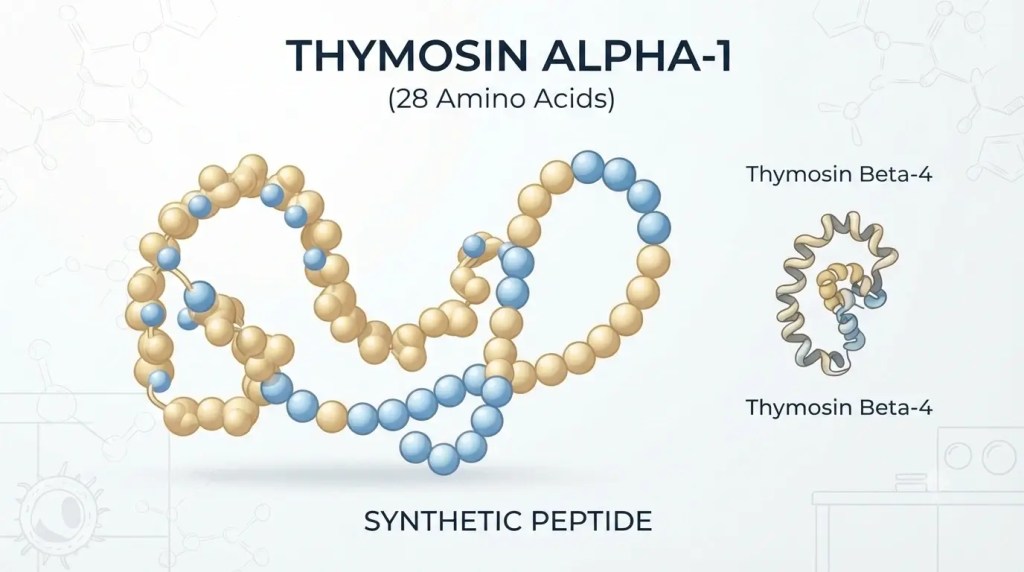
Thymosin Alpha-1 vs. Thymosin Beta-4
The names can be confusing because both compounds belong to the broader thymosin family.
Thymosin Alpha-1 is primarily associated with immune regulation. Research has examined its effects on T cells, dendritic cells, natural killer cells, cytokine signaling, and other parts of the immune response.
Thymosin Beta-4, on the other hand, is more commonly studied in connection with actin regulation, cell migration, tissue repair, and wound-healing biology.
They should not be treated as interchangeable simply because they share the word “thymosin.”
This distinction is especially important when reading peptide-related information online, where different compounds are sometimes grouped together too loosely.

How Does Thymosin Alpha-1 Work?
The exact effects of Thymosin Alpha-1 are still being investigated, but research suggests that the peptide can influence both innate and adaptive immune responses.
Several types of immune cells have been studied in connection with Thymosin Alpha-1, including:
- T lymphocytes
- Dendritic cells
- Natural killer cells
- Monocytes and other immune cells
The peptide has also been investigated for its effects on cytokine signaling and toll-like receptor pathways.
Rather than thinking of Thymosin Alpha-1 as something that simply “turns the immune system up,” it is more accurate to think of it as a compound that may influence how immune cells communicate and coordinate their responses.
That difference becomes particularly important in conditions involving either inadequate immune responses or excessive inflammation.
Thymosin Alpha-1 and T Cells
T cells are an important part of the adaptive immune system.
They help recognize infected or abnormal cells and coordinate different aspects of the body’s immune response.
Research involving Thymosin Alpha-1 has examined whether the peptide can influence T-cell activity, maturation, and function.
This is one reason the peptide has been investigated in situations where immune function may be impaired or altered.
However, findings from cellular or laboratory studies do not automatically translate into a proven treatment benefit in people. Human clinical research is needed to determine whether a biological effect produces a meaningful improvement in a specific disease.
Thymosin Alpha-1 and Dendritic Cells
Dendritic cells help connect the body’s early immune response with the more specialized adaptive immune system.
They collect information about potential threats and help activate appropriate T-cell responses.
Some research suggests that Thymosin Alpha-1 can influence dendritic-cell activity and antigen presentation.
This has helped researchers understand why the peptide has attracted interest in infectious-disease research.
Still, an effect on dendritic cells is a biological observation rather than proof that Thymosin Alpha-1 will successfully treat an infection.
Toll-Like Receptors and Cytokine Signaling
Another area of interest is the interaction between Thymosin Alpha-1 and toll-like receptor pathways.
Toll-like receptors help immune cells recognize signals associated with pathogens and tissue damage. Their activation can influence the release of cytokines and other signaling molecules.
Research suggests that Thymosin Alpha-1 may affect these pathways and help shape the body’s immune response.
This may partly explain why the peptide has been studied in viral infections and conditions involving immune dysfunction.
However, immune signaling is complicated. Changing one pathway can influence several others, and the outcome can depend on the person’s condition, immune status, and other treatments.
What Is Thymosin Alpha-1 Used For?
Thymosin Alpha-1 has been studied in several medical and research settings.
Some of the most notable areas include:
- Chronic hepatitis B
- Chronic hepatitis C
- Severe infections
- Sepsis
- Immune dysfunction
- Certain cancer-related immunotherapy settings
- Viral illness research
The amount and quality of evidence differ substantially between these areas.
Some countries have used or approved thymalfasin for particular medical indications, while its regulatory status and approved uses differ between countries.
For that reason, it is not accurate to describe Thymosin Alpha-1 as a universally approved treatment for every condition in which it has been researched.
Thymosin Alpha-1 and Viral Infections
Viral infections have been one of the major areas of interest surrounding Thymosin Alpha-1.
The reason is largely related to its potential effects on immune-cell communication and antiviral immune responses.
Research has included chronic hepatitis viruses as well as other serious viral illnesses.
The concept is different from that of a conventional antiviral medication. Thymosin Alpha-1 does not simply target a virus and eliminate it. Instead, researchers have investigated whether modifying the host immune response could help the body respond more effectively.
That distinction is important because an immune-modulating treatment cannot automatically replace disease-specific antiviral therapy.
Thymosin Alpha-1 and Chronic Hepatitis
Chronic hepatitis B is one of the better-studied clinical areas for Thymosin Alpha-1.
Clinical research has examined the peptide both on its own and alongside other treatments. Some studies have reported changes in viral or biochemical markers, although results have varied between studies.
Research has also explored Thymosin Alpha-1 in chronic hepatitis C, particularly during periods when interferon-based treatments were commonly used.
Modern hepatitis C treatment has changed substantially, however. Newer direct-acting antiviral medications have transformed the treatment landscape, meaning that older studies involving Thymosin Alpha-1 and hepatitis C should be interpreted within their historical context.
Thymosin Alpha-1 and Sepsis Research
Sepsis is a severe medical condition in which the body’s response to infection can become dangerously dysregulated.
Researchers have investigated immune-modulating treatments such as Thymosin Alpha-1 because severe infections can involve significant changes in immune function.
Clinical studies and reviews have explored whether Thymosin Alpha-1 might have a role in supporting immune responses in selected critically ill patients.
This is an area where context is especially important. Sepsis requires urgent hospital-based medical care, and experimental or adjunctive therapies should never be viewed as substitutes for established treatment.
Thymosin Alpha-1 and COVID-19 Research
During the COVID-19 pandemic, researchers investigated a wide range of immune-modulating treatments, including Thymosin Alpha-1.
Some studies examined its potential role in patients with severe disease or altered immune responses.
The results have been mixed, and differences in disease severity, timing, patient populations, and study design make the findings difficult to generalize.
This research remains an example of why a promising biological mechanism does not necessarily translate into a universally effective treatment.
Potential Benefits of Thymosin Alpha-1
The potential benefits discussed in scientific literature are mainly related to immune regulation.
Research has explored whether Thymosin Alpha-1 may:
- Influence T-cell function
- Support dendritic-cell activity
- Affect natural killer cell responses
- Modulate cytokine signaling
- Influence antiviral immune responses
- Help regulate immune responses during certain infections
The strength of evidence varies considerably.
A useful way to evaluate any claimed benefit is to ask whether it comes from laboratory research, animal studies, early human research, controlled clinical trials, or established medical practice.
These levels of evidence should not be treated as equivalent.
Is Thymosin Alpha-1 an Immune Booster?
Calling Thymosin Alpha-1 an “immune booster” is an oversimplification.
The immune system is not like a battery that simply needs more power. It needs to respond strongly enough to deal with threats while also avoiding unnecessary or excessive inflammation.
Thymosin Alpha-1 is therefore better described as an immune-modulating peptide.
This distinction may seem minor, but it is scientifically important. A substance that changes immune activity could potentially have very different effects depending on a person’s health, immune condition, infection, medications, and underlying disease.
Safety and Side Effects
The safety profile of Thymosin Alpha-1 depends on the specific product, medical context, health condition, and other treatments involved.
Published studies have generally described many adverse effects as mild, but that does not mean the peptide is risk-free.
Potential reactions reported in clinical contexts can include local reactions and other nonspecific symptoms.
More importantly, long-term safety cannot be inferred simply from short-term studies. People with immune disorders, autoimmune conditions, cancer, infections, or other significant health problems may have very different risk considerations.
This is one reason immune-modulating compounds should be evaluated in a proper medical context rather than treated as ordinary wellness supplements.
Is Thymosin Alpha-1 FDA Approved?
The regulatory status of Thymosin Alpha-1 depends on the country and the specific product.
Thymalfasin has been used or approved for particular medical applications in some countries, but that does not mean it has the same regulatory status everywhere.
In the United States, regulatory status should be checked against current FDA information rather than relying on claims made by peptide vendors or social-media posts.
Approval for one indication or in one country also does not automatically establish approval for unrelated conditions.
What Does the Research Actually Show?
The scientific literature surrounding Thymosin Alpha-1 is larger than that of many experimental peptides.
There is meaningful clinical research involving chronic viral hepatitis and immune-related conditions, along with studies involving severe infections and other settings.
At the same time, the results are not uniform across every condition.
Some studies focus on immune markers. Others examine viral measurements, infection rates, survival, or treatment response. These outcomes are not interchangeable.
This is why it is important to avoid taking one positive result and applying it broadly to every possible use of Thymosin Alpha-1.
The most accurate conclusion is that Thymosin Alpha-1 is a biologically active immune-modulating peptide with legitimate clinical research behind it, but its usefulness depends heavily on the particular medical situation.
Frequently Asked Questions
Final Thoughts
Thymosin Alpha-1 stands out from many peptides because its main area of interest is the immune system.
Research has shown that it can interact with several important components of immune regulation, including T cells, dendritic cells, natural killer cells, cytokine signaling, and toll-like receptor pathways.
Those biological effects have led to decades of research involving chronic hepatitis, severe infections, sepsis, and other immune-related conditions.
At the same time, it is important not to turn the science into a simple “immune booster” story. Immune regulation is complicated, and a treatment that changes immune activity may have very different implications depending on the individual and the disease.
The strongest way to understand Thymosin Alpha-1 is to look at the evidence for each specific medical application rather than assuming that results from one condition apply to another.
For now, Thymosin Alpha-1 remains an interesting and relatively well-studied immune-modulating peptide, but its appropriate use depends on the medical context, available evidence, regulatory status, and professional medical judgment.
Disclaimer: This article is intended for general educational purposes only. It is not medical advice and does not provide dosing, administration, or self-treatment instructions. Thymosin Alpha-1 should be discussed with a qualified healthcare professional when considered in a medical context.