KLOW is a name that appears frequently in discussions about experimental peptide blends, particularly around tissue repair, inflammation, skin health, and recovery. Unlike a conventional pharmaceutical with one clearly defined active ingredient, KLOW is generally used to describe a combination of several peptides.
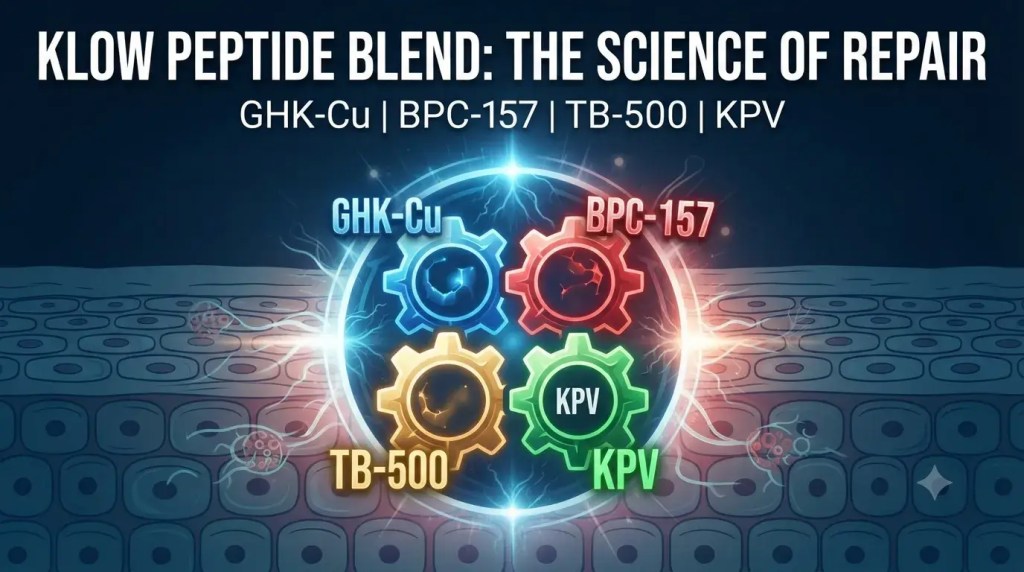
The exact formulation can vary, but KLOW is commonly associated with four ingredients: GHK-Cu, BPC-157, TB-500 or thymosin beta-4-related material, and KPV. Each of these compounds has a different area of biological research, which is part of the reason KLOW has attracted attention.
The proposed idea behind the combination is straightforward: different peptides may influence different aspects of tissue biology, inflammatory signaling, cell migration, and repair. That sounds promising, but there is an important limitation. Evidence about the individual components does not automatically prove that the complete KLOW blend works in humans.
This guide looks at what KLOW is, the peptides commonly associated with it, the science behind its proposed effects, potential research areas, safety considerations, and what remains unknown.
What Is KLOW Peptide?
KLOW is best understood as a proposed peptide blend rather than one standardized peptide molecule.
That distinction matters. A conventional approved medication has a defined active ingredient, standardized manufacturing, established labeling, and a clinical safety and effectiveness profile. A peptide blend may not have the same level of regulatory evaluation.
The name KLOW is generally associated with a combination of:
- GHK-Cu
- BPC-157
- TB-500 or thymosin beta-4-related compounds
- KPV
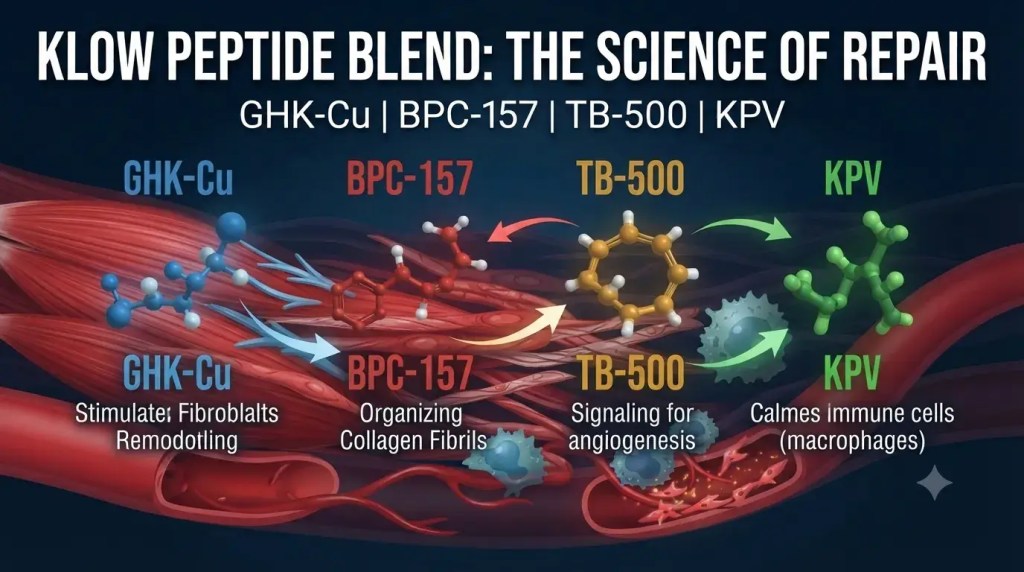
These compounds are studied in different areas of biology. GHK-Cu has been associated with skin and extracellular-matrix research, BPC-157 with experimental tissue-repair models, thymosin beta-4 with cell migration and wound-healing biology, and KPV with inflammatory signaling.
Because formulations can differ, the composition of a particular product should never be assumed simply because it is labeled “KLOW.”
What Is in the KLOW Blend?
Understanding the individual components provides a better picture of why this combination has become popular in peptide discussions.
GHK-Cu
GHK-Cu is a copper-binding peptide made from glycine, histidine, and lysine in association with copper.
It has been studied extensively in skin biology and tissue remodeling. Research has examined its relationship with collagen, extracellular-matrix processes, fibroblast activity, and other pathways involved in tissue repair.
This is one reason GHK-Cu is often associated with skin health and wound-healing discussions.
However, laboratory findings about collagen or cellular pathways should not automatically be interpreted as proof of broad anti-ageing or regenerative effects in humans.
BPC-157
BPC-157 is a synthetic peptide that has received considerable attention in experimental research involving tissue repair.
Studies have examined areas such as gastric tissue, tendons, ligaments, muscle, blood vessels, and wound models. Much of this research is preclinical, meaning that it involves laboratory or animal models rather than large human clinical trials.
That makes BPC-157 an interesting research compound, but it also means claims about treating human injuries need to be viewed carefully.
TB-500 and Thymosin Beta-4
TB-500 is frequently discussed alongside thymosin beta-4, although the two should not automatically be considered identical.
Thymosin beta-4 is a naturally occurring peptide involved in actin-related cellular processes and has been studied in areas such as cell migration, wound healing, angiogenesis, and tissue repair.
Because commercially discussed TB-500 products may differ from specific research preparations, evidence involving thymosin beta-4 should not automatically be treated as evidence for every product described as TB-500.
KPV
KPV is a small peptide sequence derived from the C-terminal portion of alpha-melanocyte-stimulating hormone.
Research has explored KPV in relation to inflammatory signaling, including experimental models involving intestinal inflammation.
This helps explain why KPV is included in discussions about inflammatory control and gut-related research.
Again, an experimental effect does not establish KPV—or a KLOW blend containing it—as a proven treatment for an inflammatory disease.
How Is KLOW Supposed to Work?
There is no single established mechanism for KLOW because it is a combination of different compounds.
Instead, the proposed rationale comes from the biological effects being studied for each individual component.
GHK-Cu is associated with extracellular-matrix and skin biology. BPC-157 has been studied in experimental tissue-repair models. Thymosin beta-4 is associated with cell migration and repair processes, while KPV has been investigated for inflammatory signaling.
The theory is that these different effects could complement one another.
That is a hypothesis, however—not a demonstrated clinical fact.
When several compounds are combined, their interactions can also become more complicated. A combination may produce unexpected effects that would not be obvious from studying each component separately.
KLOW and Inflammation Research
Inflammation is one of the main reasons KLOW appears in discussions about recovery and tissue repair.
The immune system uses inflammation as part of its response to injury and infection. While inflammation can be useful, excessive or prolonged inflammation can also contribute to tissue damage and chronic disease.
Several KLOW-associated peptides have been investigated in different inflammatory pathways.
KPV, for example, has been studied in experimental models involving inflammatory signaling. GHK-Cu and thymosin beta-4 research also overlaps with tissue remodeling and inflammatory processes.
But “reduces inflammation” is an extremely broad statement.
Inflammation in the skin, intestine, joints, muscles, and other tissues involves different biological processes. Evidence from one model cannot automatically be applied to every inflammatory condition.
KLOW and Tissue Repair
Tissue repair is another major area associated with KLOW.
The body repairs damaged tissue through a series of coordinated processes involving inflammation, cell migration, extracellular-matrix remodeling, blood-vessel formation, and tissue maturation.
Several of the peptides associated with KLOW have been studied in one or more of these areas.
BPC-157 research, for example, has included experimental models of tendon, ligament, muscle, and gastrointestinal injury. Thymosin beta-4 has been studied in wound-healing and cell-migration research, while GHK-Cu has been associated with extracellular-matrix and skin biology.
These findings help explain the interest in KLOW.
They do not, however, establish that the complete blend can reliably accelerate healing in people.
KLOW and Skin Health
The GHK-Cu component is particularly relevant to the skin-related side of KLOW research.
GHK-Cu has been studied in connection with collagen, elastin, extracellular-matrix remodeling, and other processes involved in skin structure.
Thymosin beta-4 has also been researched in relation to wound healing and cellular migration.
This has led to online claims involving skin rejuvenation, wound repair, and improved skin appearance.
The scientific evidence should be interpreted more carefully than those marketing claims suggest. A biological pathway associated with skin repair is not the same as a demonstrated cosmetic or therapeutic outcome.
KLOW and Gut Health Research
BPC-157 and KPV have both been discussed in relation to gastrointestinal research.
BPC-157 has been studied in experimental models involving the stomach and intestinal tract, while KPV has been investigated in models of intestinal inflammation.
These findings have contributed to the idea that KLOW may have potential applications involving gut health.
However, there is currently a large difference between studying intestinal inflammation in an experimental model and demonstrating that a multi-peptide blend safely treats a human gastrointestinal disease.
Conditions such as inflammatory bowel disease require proper medical diagnosis and evidence-based treatment.
KLOW and Injury Recovery
Injury recovery is another common topic surrounding KLOW.
The proposed connection comes mainly from research involving BPC-157 and thymosin beta-4-related biology.
Laboratory and animal studies have investigated processes such as cell migration, blood-vessel formation, tissue remodeling, and repair.
These mechanisms are relevant to healing, but recovery from a human injury depends on many factors, including the type and severity of the injury, blood supply, mechanical stress, nutrition, rehabilitation, and underlying health.
For that reason, KLOW should not be presented as an established treatment for tendon, ligament, muscle, or other injuries.
Potential Benefits of KLOW
The potential benefits associated with KLOW largely come from research into its individual components.
Areas of interest include:
- Tissue-repair biology
- Inflammatory signaling
- Skin and extracellular-matrix biology
- Wound-healing research
- Cell migration
- Gut and intestinal research
- Tendon and ligament research
- Cellular recovery
The evidence behind these areas is not equally strong.
Some findings come from laboratory experiments, some from animal studies, and a much smaller amount of evidence comes from human research. Direct clinical evidence for the complete KLOW blend appears limited.
That distinction is essential when evaluating claims about its benefits.
Does KLOW Have Synergistic Effects?
The idea of synergy is one of the most interesting aspects of a multi-peptide blend.
In theory, different peptides could influence different biological processes at the same time. One might affect inflammatory signaling, another tissue remodeling, and another cell migration.
But synergy cannot simply be assumed.
Combining compounds can also change their exposure, biological activity, and potential adverse effects. To demonstrate true synergy, researchers would need to study the complete combination directly and compare it with the individual components.
Without those studies, the proposed synergy behind KLOW remains a hypothesis.
KLOW Safety and Side Effects
Safety is one of the biggest unanswered questions surrounding KLOW.
Because KLOW is not one standardized pharmaceutical ingredient, safety depends on the exact formulation and the properties of each component.
There is also limited long-term human evidence examining the complete combination.
Another concern is product quality. Experimental peptide products may differ in purity, concentration, sterility, storage, and manufacturing standards.
Even if individual peptides have been studied separately, their combination does not automatically inherit the safety profile of each component.
This is why experimental peptide blends should not be treated like ordinary nutritional supplements.
Is KLOW FDA Approved?
KLOW should not be described as an FDA-approved peptide medication.
The term refers to a proposed peptide combination rather than a single standardized drug with an FDA-approved label. The reference literature likewise notes that there is no general FDA-approved KLOW protocol.
Regulatory status is important because approval involves evaluation of product identity, quality, safety, effectiveness, and appropriate medical use.
Scientific interest alone does not establish regulatory approval.
What Does the Research Actually Show?
The research behind KLOW is best understood by separating component-level evidence from blend-level evidence.
There is published research on several individual components. GHK-Cu has a body of literature involving skin and tissue biology. Thymosin beta-4 has been studied in wound-healing and cellular processes. BPC-157 and KPV have attracted interest largely through experimental and preclinical research.
The situation is different when the four compounds are considered as one blend.
Direct clinical studies evaluating the complete KLOW formulation appear limited. That means it is not scientifically appropriate to simply add together the research findings for four separate compounds and treat them as proof that the combination produces all of the claimed benefits.
The best description at this stage is that KLOW represents an experimental multi-peptide concept supported by varying levels of component research.
Frequently Asked Questions
Final Thoughts
KLOW is an interesting example of how peptide research can move from individual compounds into multi-peptide combinations.
The concept brings together four compounds that have attracted attention for different reasons: GHK-Cu for skin and tissue biology, BPC-157 for experimental repair research, thymosin beta-4-related compounds for cell migration and wound-healing research, and KPV for inflammatory signaling.
There are legitimate scientific questions behind each of these areas.
At the same time, it would be misleading to treat the research on the individual peptides as proof that the complete KLOW blend produces the same effects in humans. Direct clinical evidence for the combination remains limited, and the long-term safety profile is not well established.
The most useful way to understand KLOW is therefore to separate what has been observed in laboratory research, what has been studied in animals, what has been evaluated in humans, and what remains speculation.
For now, KLOW is best viewed as an experimental peptide-blend concept rather than an established medical treatment.
Disclaimer: This article is intended for general educational purposes only. It is not medical advice and does not provide dosing, reconstitution, administration, or self-treatment instructions. Experimental peptide blends should not be used as substitutes for appropriate medical evaluation or evidence-based treatment.