
CJC-1295 No DAC is a synthetic peptide that has attracted attention because of its relationship with growth hormone-releasing hormone and the body’s growth hormone pathway.
It is often discussed alongside growth hormone, IGF-1, muscle development, recovery, sleep, and body composition. However, many of the claims found online are considerably broader than the available clinical evidence.
There is also an important point that is sometimes overlooked: CJC-1295 No DAC and CJC-1295 DAC are not the same form of the peptide. The DAC version contains a modification designed to extend its time in circulation, while the No DAC form lacks that modification. As a result, research involving one form should not automatically be applied to the other.
This guide explains what CJC-1295 No DAC is, how it relates to the growth hormone system, why it is different from the DAC version, what researchers have studied, and what is currently known about its safety and limitations.
What Is CJC-1295 No DAC?
CJC-1295 No DAC is generally described as a modified analogue of growth hormone-releasing hormone, or GHRH.
GHRH is a naturally occurring hormone involved in regulating the release of growth hormone from the pituitary gland. CJC-1295 No DAC is discussed in research because of its ability to interact with this biological pathway.
You may also see CJC-1295 No DAC referred to as Modified GRF (1-29) or other similar names. Unfortunately, naming around CJC-1295 can be confusing because several chemically different substances are discussed under closely related names.
This is more than a technical issue. Different forms can have different pharmacological properties, durations of action, and evidence bases. Regulatory reviews have specifically highlighted confusion surrounding the identity and naming of CJC-1295-related substances.
What Does “No DAC” Mean?
The “No DAC” part of the name refers to the absence of the Drug Affinity Complex.
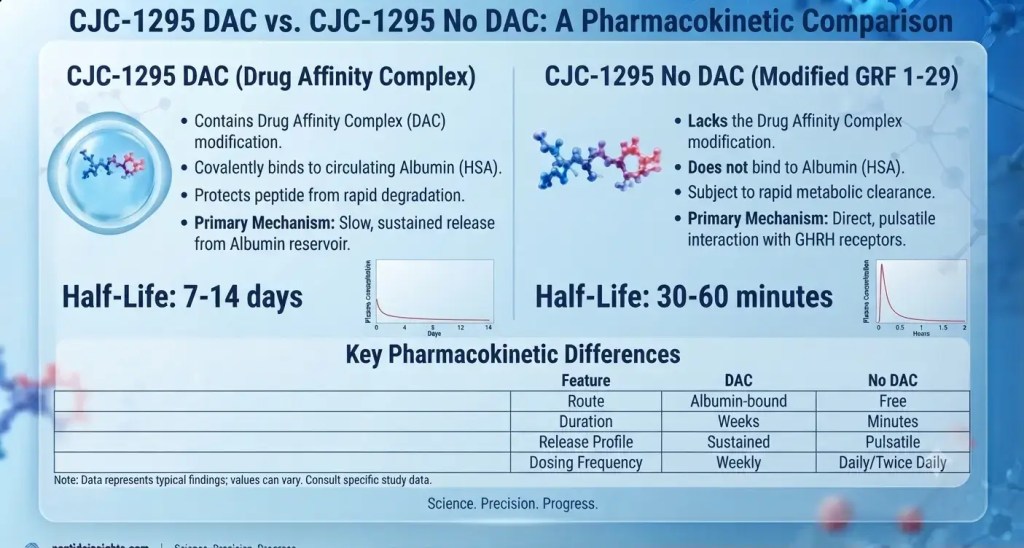
The DAC modification was developed to allow CJC-1295 to bind with albumin in the bloodstream. This interaction was intended to extend the peptide’s exposure and create a longer-acting form.
CJC-1295 No DAC does not contain this modification.
That difference is important because the pharmacokinetic behavior of the two forms can be very different. Research involving the longer-acting DAC version should not automatically be used to describe how the No DAC version behaves in the body.
CJC-1295 DAC vs CJC-1295 No DAC
The two forms are closely related, but they should not be treated as interchangeable.
CJC-1295 DAC
The DAC form contains the Drug Affinity Complex modification associated with albumin binding. Human research has reported prolonged exposure and sustained changes in growth hormone and IGF-1 levels following administration of the DAC form.
CJC-1295 No DAC
The No DAC form lacks the albumin-binding modification. It is therefore expected to have a different exposure profile and shorter duration than the DAC version.
This distinction is particularly important when reading online articles. A study involving CJC-1295 DAC does not automatically establish the same effects, duration, or safety profile for CJC-1295 No DAC.
How Does CJC-1295 No DAC Work?
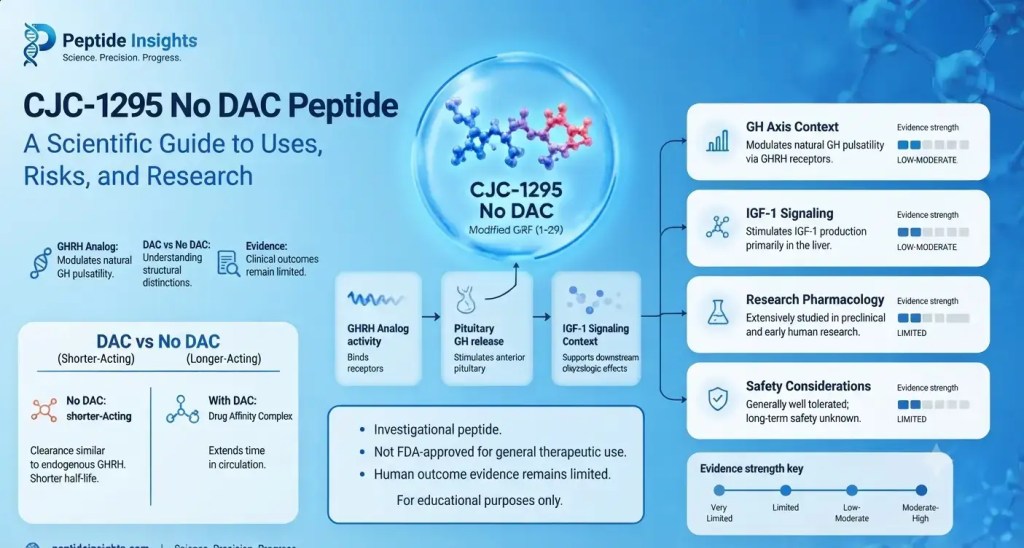
CJC-1295 No DAC is discussed in connection with the GHRH pathway, which plays a central role in growth hormone regulation.
The hypothalamus releases GHRH, which acts on the pituitary gland and helps stimulate growth hormone secretion. Another hormone called somatostatin works in the opposite direction by suppressing growth hormone release.
This creates a tightly regulated system rather than a simple on-and-off switch.
Growth hormone also interacts with another important hormone called IGF-1, or insulin-like growth factor 1. Much of the body’s growth hormone activity involves this broader GH–IGF-1 axis.
Because CJC-1295 No DAC is associated with the GHRH pathway, discussions about the peptide often focus on GH and IGF-1.
However, a biologically plausible mechanism does not automatically mean that a peptide produces a proven health benefit.
Understanding the Growth Hormone and IGF-1 Axis
Growth hormone is naturally released in pulses rather than at a constant level.
Its secretion is influenced by several factors, including GHRH, somatostatin, ghrelin, sleep, age, metabolism, and feedback from IGF-1.
After growth hormone is released, it acts on different tissues and can stimulate IGF-1 production. IGF-1 then participates in several processes involving growth, metabolism, and tissue biology.
This is why CJC-1295 is often discussed in connection with muscle, recovery, body composition, and other physical outcomes.
But the existence of this biological pathway should not be mistaken for evidence that CJC-1295 No DAC produces all of the benefits commonly claimed online.
Potential Benefits of CJC-1295 No DAC
CJC-1295 No DAC is often associated with several potential benefits in online peptide discussions.
Common claims include possible effects on:
- Growth hormone signaling
- IGF-1 levels
- Recovery
- Body composition
- Muscle development
- Sleep
- Energy
- Physical performance
Some of these claims are based on the known biology of the growth hormone system, while others come from anecdotal reports or extrapolation from research involving different CJC-1295 forms.
The distinction matters.
At present, there is not enough high-quality clinical evidence to treat broad claims about CJC-1295 No DAC as established medical benefits.
CJC-1295 and Growth Hormone Research
Much of the scientific interest in CJC-1295 comes from its relationship with growth hormone.
Human studies involving CJC-1295 DAC have demonstrated that the compound can affect GH and IGF-1 levels. However, these studies involved the DAC form and were conducted primarily in healthy adults.
That evidence provides useful information about the general pharmacology of CJC-1295-related compounds, but it does not establish that CJC-1295 No DAC is an effective treatment for a particular disease or condition.
This is one of the most important points to keep in mind when reading about the peptide.
CJC-1295 and Muscle Growth
CJC-1295 is frequently discussed in fitness and bodybuilding communities because growth hormone and IGF-1 are involved in processes related to muscle and tissue biology.
That has led to claims that CJC-1295 can directly increase muscle mass or improve athletic performance.
The problem is that changes in hormone levels do not necessarily translate into meaningful improvements in strength, muscle development, or athletic performance.
There is also limited clinical evidence specifically evaluating CJC-1295 No DAC for these outcomes.
As a result, it would be inaccurate to describe the peptide as a proven muscle-building treatment.
CJC-1295 and Body Composition
Another common claim involves fat loss and changes in body composition.
Growth hormone has well-known effects on metabolism, which helps explain why this connection exists. However, the metabolic effects of growth hormone signaling are complex, and changes in hormone concentrations do not automatically result in predictable changes in body fat.
Claims that CJC-1295 No DAC is a reliable fat-loss peptide therefore require considerably more evidence than is currently available.
CJC-1295 and Sleep
Growth hormone secretion is closely connected with sleep, particularly deep or slow-wave sleep.
Because CJC-1295 is associated with the growth hormone pathway, sleep is sometimes mentioned as a potential benefit.
However, the relationship between growth hormone and sleep is complicated. A biological relationship does not establish that CJC-1295 No DAC improves sleep quality in people.
More direct clinical research would be needed to determine whether the peptide provides a meaningful benefit for sleep-related outcomes.
What Does Human Research Tell Us?
This is where the evidence becomes especially important.
The strongest published human evidence involving CJC-1295 has focused on the DAC form, particularly in healthy adults.
Regulatory review has noted that human studies of CJC-1295 have been limited and that evidence in people with diagnosed diseases or medical conditions is lacking.
That means there is a substantial gap between the amount of online discussion surrounding CJC-1295 and the amount of high-quality clinical evidence supporting specific therapeutic uses.
For readers, this is an important distinction:
A peptide can have an interesting mechanism without being a proven treatment.
Safety and Side Effects
Safety is another important consideration with CJC-1295.
Because CJC-1295 is an experimental peptide rather than a broadly established therapeutic treatment, long-term safety information is limited.
Regulatory reviews have raised concerns involving compounded CJC-1295, including potential immunogenicity, peptide impurities, characterization problems, and reported systemic reactions such as increased heart rate and vasodilatory responses.
The quality of products obtained outside regulated medical channels can also vary. A label alone does not guarantee that a product contains the expected substance at the expected purity.
These concerns make it particularly important not to treat research peptides like ordinary nutritional supplements.
Is CJC-1295 FDA Approved?
CJC-1295 should not be described as an FDA-approved treatment for muscle growth, fat loss, anti-ageing, recovery, or general wellness.
Regulatory status matters because approval requires evidence concerning a product’s identity, quality, safety, effectiveness, and appropriate medical use.
The fact that a compound appears in scientific literature does not mean that it has been approved as a medication.
Why the Difference Between DAC and No DAC Matters
One of the biggest problems with online CJC-1295 information is the tendency to combine evidence from different forms.
For example, a study involving CJC-1295 DAC may report prolonged exposure or sustained changes in GH and IGF-1. That does not mean the same pharmacokinetic profile applies to CJC-1295 No DAC.
The two forms have different chemical characteristics.
When evaluating a study, it is therefore worth checking:
- Which CJC-1295 form was studied?
- Who participated in the study?
- What outcome was measured?
- Was the study conducted in humans?
- Was the study designed to evaluate a medical benefit or simply a biological effect?
These questions can prevent many misleading conclusions.
Frequently Asked Questions
Final Thoughts
CJC-1295 No DAC is an interesting peptide because it interacts with one of the body’s most important hormone-regulation systems.
Its connection with GHRH, growth hormone, and IGF-1 explains why it has attracted so much attention in research and online discussions about performance, recovery, body composition, and ageing.
But the science needs to be kept in perspective.
Much of the stronger human evidence surrounding CJC-1295 involves the DAC form, not necessarily the No DAC form. The two should not be treated as interchangeable, and claims about one cannot automatically be transferred to the other.
For now, CJC-1295 No DAC is best understood as an experimental peptide associated with growth hormone research, rather than a proven treatment for muscle growth, fat loss, recovery, sleep, or longevity.
Disclaimer: This article is intended for general educational purposes only. It is not medical advice and does not provide dosing, reconstitution, administration, or self-treatment instructions. CJC-1295 is an experimental peptide, and questions about hormones, growth hormone pathways, or potential treatments should be discussed with a qualified healthcare professional.