
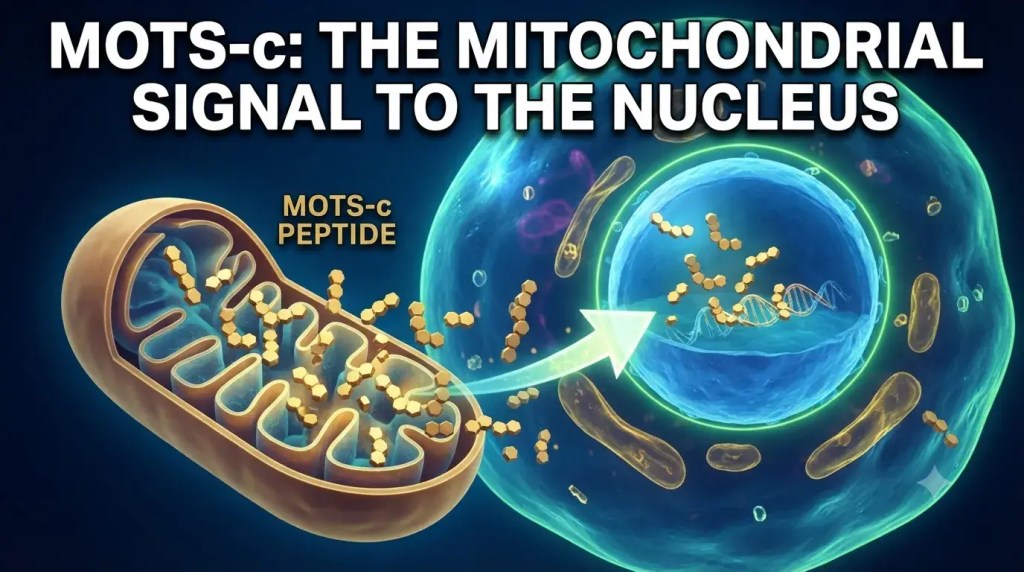
MOTS-c is a small peptide that has attracted growing interest in research on metabolism, mitochondrial function, exercise, and healthy ageing.
What makes MOTS-c particularly interesting is where it comes from. Unlike many peptides that are encoded by nuclear DNA, MOTS-c is associated with the mitochondrial genome. Researchers have proposed that it acts as a signaling molecule that helps connect mitochondrial activity with broader metabolic processes in the cell.
That connection has made MOTS-c a popular subject in longevity and metabolic research. Studies have explored its relationship with glucose metabolism, insulin sensitivity, cellular energy sensing, exercise adaptation, and age-related changes in muscle function.
At the same time, much of the research is still in the early stages. Interesting findings in cells and animals do not automatically mean that MOTS-c is an effective treatment for diabetes, obesity, ageing, or other human conditions.
This guide looks at what MOTS-c is, how researchers think it works, its potential areas of research, what is currently known about its benefits and safety, and where important questions remain unanswered.
What Is MOTS-c?
MOTS-c stands for Mitochondrial Open Reading Frame of the 12S rRNA-c.
It is a short peptide consisting of 16 amino acids and is classified as a mitochondrial-derived peptide, or MDP. These peptides are unusual because they are associated with genetic information within mitochondria rather than following the more familiar pattern of proteins encoded by nuclear DNA.
Mitochondria are best known as the structures responsible for producing much of the cell’s usable energy. However, modern research has shown that mitochondria are involved in much more than energy production.
They participate in processes involving metabolism, stress responses, cellular signaling, and communication with the nucleus.
MOTS-c has become interesting because it may be part of this communication system.
Why Is MOTS-c Considered a Mitochondrial-Derived Peptide?
Human mitochondria contain their own small genome. Researchers studying mitochondrial biology discovered that this genetic material may encode more signaling molecules than previously appreciated.
MOTS-c is associated with an open reading frame within the mitochondrial 12S ribosomal RNA region, also known as MT-RNR1.
This makes MOTS-c different from many conventional peptide hormones.
Rather than simply acting like a traditional hormone with one well-defined receptor, MOTS-c is being studied as part of a broader network involving mitochondrial function, cellular metabolism, stress responses, and gene regulation.
That is one reason the peptide has generated so much scientific interest.
MOTS-c and Mitochondrial Function
Mitochondria constantly respond to the energy demands of a cell.
When energy requirements change, cells must adjust how they use glucose, fatty acids, and other nutrients. They also need mechanisms that help them respond to metabolic stress.
Research suggests that MOTS-c may participate in this process.
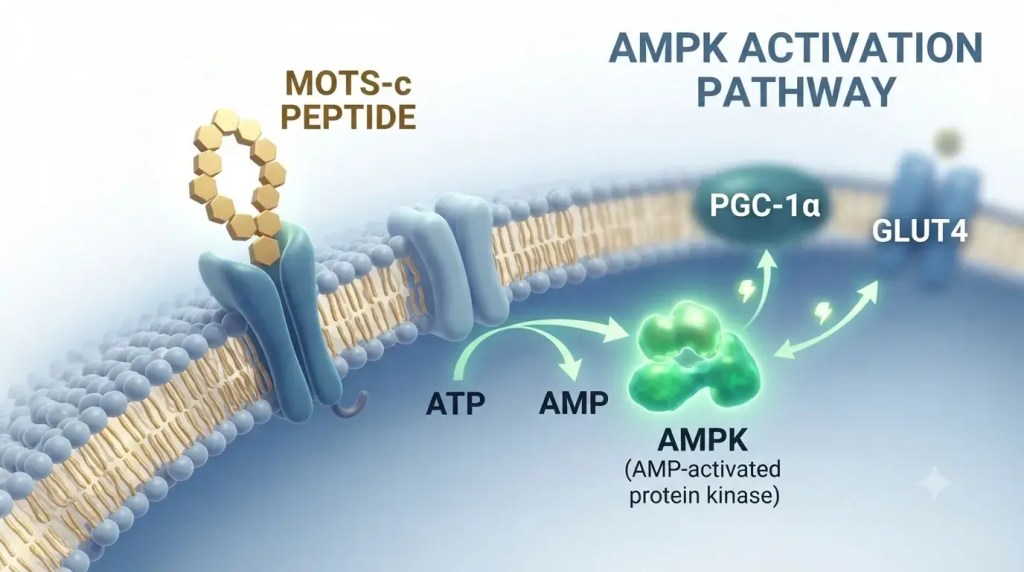
Experimental studies have connected MOTS-c with pathways involved in energy sensing and metabolic regulation. One of the most frequently discussed pathways is AMP-activated protein kinase, commonly known as AMPK.
AMPK acts as an important cellular energy sensor. It helps cells respond when energy availability changes and can influence how nutrients are used.
The connection between MOTS-c and AMPK is one of the main reasons researchers are interested in its possible metabolic effects.
How Does MOTS-c Work?
The exact mechanism of MOTS-c is still being investigated.
Research has suggested that the peptide may influence several interconnected processes involving energy metabolism, glucose handling, cellular stress, and communication between mitochondria and the nucleus.
One particularly interesting finding is that MOTS-c can move into the nucleus under certain metabolic-stress conditions. Researchers have proposed that this allows it to influence gene expression and cellular responses.
This process is sometimes described as mitochondrial-to-nuclear communication or retrograde signaling.
In simple terms, the idea is that mitochondria may send information about the cell’s metabolic state to the nucleus, allowing the cell to adjust its behavior.
This is an exciting area of biology, but the existence of a mechanism does not prove that externally administered MOTS-c will produce a meaningful health benefit in humans.
MOTS-c and AMPK
AMPK is one of the central pathways discussed in MOTS-c research.
It functions as an energy sensor and helps cells adapt to changes in energy availability. When cellular energy is low, AMPK can promote processes that generate energy while reducing certain energy-consuming activities.
Early MOTS-c studies found effects involving AMPK-related signaling in experimental models. These findings helped establish the connection between the peptide and metabolic regulation.
Because AMPK is also involved in glucose and energy metabolism, researchers have explored whether MOTS-c could have relevance to metabolic disorders.
However, it would be inaccurate to describe MOTS-c as an established diabetes treatment simply because it affects AMPK.
MOTS-c and Glucose Metabolism
Glucose metabolism is one of the major areas of MOTS-c research.
Cells need to maintain a relatively stable supply of energy, and glucose is one of the body’s most important fuels. Problems with glucose regulation are associated with conditions such as insulin resistance and type 2 diabetes.
Preclinical research has suggested that MOTS-c may influence glucose handling and metabolic homeostasis. Some studies have reported changes in insulin sensitivity and related metabolic pathways.
These findings are scientifically interesting, but most of the evidence remains preclinical or early-stage.
A compound can improve glucose-related measurements in an animal model without necessarily becoming a safe or effective treatment for diabetes in humans.
MOTS-c and Insulin Sensitivity
Insulin helps regulate how the body uses and stores glucose.
When tissues become less responsive to insulin, the body may need to produce more insulin to maintain normal blood glucose levels. This condition, known as insulin resistance, is an important feature of several metabolic disorders.
MOTS-c has been studied because of its potential relationship with insulin signaling and metabolic flexibility.
Some experimental research suggests that MOTS-c may improve metabolic responses under certain conditions. These findings have contributed to interest in the peptide as a possible research target for metabolic disease.
However, there is currently not enough clinical evidence to establish MOTS-c as a treatment for insulin resistance or diabetes.
MOTS-c and Exercise
Exercise is another important area of MOTS-c research.
Physical activity places temporary demands on the body’s energy systems. Muscles need to increase energy production, adjust fuel usage, and respond to metabolic stress.
Researchers have found connections between MOTS-c, skeletal muscle, and exercise-related metabolic adaptation. Some studies have investigated whether MOTS-c levels or signaling change in response to physical activity.
This has led to interest in MOTS-c as a possible link between exercise and mitochondrial signaling.
It is important to distinguish this from the much stronger claim that MOTS-c is an exercise-enhancing treatment. The current research does not establish that conclusion.
MOTS-c and Ageing
Longevity is probably the area that has generated the most public interest in MOTS-c.
As people age, mitochondrial function and metabolic regulation can change. Muscle mass, physical performance, insulin sensitivity, and the body’s ability to respond to metabolic stress can also decline.
Because MOTS-c is connected with mitochondrial and metabolic signaling, scientists have investigated whether it may play a role in age-related changes.
Some research has examined MOTS-c in relation to age-dependent physical decline and metabolic function.
These findings are interesting, but they do not establish MOTS-c as an anti-ageing treatment.
Ageing is influenced by many biological processes, and changing one pathway is unlikely to address the entire process.
MOTS-c and Metabolic Health
MOTS-c has become particularly interesting in metabolic research because several of its proposed effects overlap with important aspects of metabolic health.
Researchers have studied relationships involving:
- Glucose metabolism
- Insulin sensitivity
- Energy sensing
- AMPK signaling
- Skeletal muscle function
- Exercise adaptation
- Metabolic stress
- Mitochondrial signaling
These areas are closely connected, but they should not be interpreted as a list of proven health benefits.
Much of the current evidence comes from laboratory and animal studies, while human research remains comparatively limited.
MOTS-c and Weight Loss Research
Weight loss is another claim frequently associated with MOTS-c.
The connection largely comes from its potential influence on energy metabolism and glucose regulation.
However, metabolic signaling is only one part of body-weight regulation. Appetite, food intake, physical activity, hormones, genetics, sleep, medications, and many other factors also influence body weight.
For that reason, the existence of metabolic effects does not establish MOTS-c as a proven weight-loss treatment.
More human research would be needed to determine whether the peptide has a meaningful and clinically relevant effect on body weight.
MOTS-c and Muscle Health
Skeletal muscle is particularly important in metabolic health because it uses a large amount of glucose and plays a major role in energy expenditure.
Research has examined MOTS-c in connection with muscle metabolism, exercise response, and age-related physical changes.
This has created interest in whether MOTS-c could eventually have applications in areas involving muscle function or age-related decline.
At present, however, most of the evidence remains experimental.
It would therefore be premature to describe MOTS-c as a proven muscle-building or performance-enhancing peptide.
MOTS-c and Healthy Ageing
Healthy ageing is broader than simply living longer.
Researchers are interested in maintaining physical function, metabolic health, cognitive function, and independence as people age.
MOTS-c is relevant to this field because its proposed biological effects involve energy regulation and cellular stress responses.
Some early research has produced interesting findings, but there is currently no strong evidence showing that MOTS-c extends human lifespan or reliably prevents age-related disease.
The distinction between longevity research and proven longevity treatment is particularly important here.
MOTS-c and Human Research
Human research is essential for determining whether promising laboratory findings translate into real-world health benefits.
Compared with the large amount of online discussion surrounding MOTS-c, the human evidence remains relatively limited.
Researchers have measured naturally occurring MOTS-c levels and examined relationships involving age, exercise, and metabolic health. These studies can provide useful information about the peptide’s biology, but measuring a naturally occurring molecule is not the same as proving that taking the molecule as a treatment produces a beneficial outcome.
This is one of the biggest limitations to keep in mind when evaluating MOTS-c claims.

Potential Benefits of MOTS-c
The potential benefits associated with MOTS-c come mainly from experimental research.
Areas of interest include:
- Metabolic regulation
- Glucose handling
- Insulin sensitivity
- Cellular energy sensing
- AMPK signaling
- Exercise adaptation
- Skeletal muscle metabolism
- Mitochondrial communication
- Age-related metabolic changes
These areas provide reasonable scientific questions for continued research.
They should not, however, be presented as established medical benefits.
The strength of evidence is different for each claim, and many of the most interesting findings have not yet been confirmed through large, well-controlled human trials.
MOTS-c Safety and Side Effects
Safety remains an important unanswered question.
MOTS-c is not an FDA-approved medication with established prescribing information, and long-term human safety data are limited. As a result, researchers do not have the same level of information about contraindications, drug interactions, and long-term adverse effects that exists for established medicines.
This is particularly important for a peptide involved in metabolic signaling.
Changing metabolic pathways can potentially affect multiple systems at once, and experimental findings cannot predict every possible effect in humans.
The quality of research products is another consideration. Material obtained outside regulated pharmaceutical manufacturing may have uncertainty around identity, purity, concentration, and contamination.
Is MOTS-c FDA Approved?
MOTS-c is not an FDA-approved medication for diabetes, weight loss, anti-ageing, exercise performance, or general metabolic health. The reference material likewise notes that there are no FDA-approved MOTS-c products or labeled indications.
This distinction is important because scientific research and regulatory approval are two different things.
A peptide can be studied extensively in laboratories and still remain an experimental compound.
Approval requires evidence demonstrating that a product has an acceptable balance of safety and effectiveness for a specific medical use.
What Does the Research Actually Show?
MOTS-c is scientifically interesting because it connects several major areas of modern biology: mitochondrial function, energy metabolism, exercise adaptation, and cellular stress responses.
The strongest mechanistic evidence comes from laboratory and animal research showing effects involving pathways such as AMPK and metabolic regulation.
The challenge is translating those findings into human medicine.
There is still a significant gap between demonstrating that MOTS-c affects a biological pathway and proving that treatment with MOTS-c improves meaningful health outcomes.
That means claims about reversing ageing, treating diabetes, producing substantial weight loss, or dramatically improving athletic performance should be treated cautiously.
Frequently Asked Questions
Final Thoughts
MOTS-c is one of the more unusual peptides in modern metabolic research.
Its connection with mitochondrial DNA and cellular energy regulation has opened an interesting area of research into how mitochondria may communicate with the rest of the cell. Studies involving AMPK, glucose metabolism, insulin sensitivity, skeletal muscle, exercise, and ageing have helped explain why researchers are interested in the peptide.
But the scientific story is still developing.
Most of the strongest evidence comes from laboratory and animal research, while human evidence remains limited. That means MOTS-c should not currently be described as a proven treatment for weight loss, diabetes, muscle growth, exercise performance, or ageing.
The most reasonable way to view MOTS-c is as an experimental mitochondrial-derived peptide with promising biological research but many unanswered clinical questions.
As research continues, better human studies may clarify whether the mechanisms observed in experimental models translate into meaningful health benefits.
Until then, separating established findings from preliminary research is the best way to understand what MOTS-c may—and may not—be able to do.
Disclaimer: This article is intended for general educational purposes only. It is not medical advice and does not provide dosing, reconstitution, administration, or self-treatment instructions. MOTS-c is an experimental peptide, and questions about metabolic health or potential treatments should be discussed with a qualified healthcare professional.