
GLOW peptide is a term commonly used in the peptide and wellness space for a combination of several experimental peptides. Unlike a conventional medication with one defined active ingredient, GLOW generally refers to a blend built around GHK-Cu, BPC-157, and TB-500 or thymosin beta-4-related compounds.
The combination has attracted attention because each component has been studied in a different area of biology. GHK-Cu is particularly associated with skin and extracellular-matrix research, while BPC-157 and thymosin beta-4-related compounds have been investigated in experimental models involving tissue repair, cell migration, and wound healing.
This has led to a wide range of claims about skin quality, collagen, recovery, inflammation, hair, and regeneration.
The science, however, is more nuanced.
Research involving an individual peptide does not automatically prove that a combination of three peptides produces the same effects in humans. Direct clinical evidence for the complete GLOW blend is limited, and the regulatory status of experimental peptide combinations is very different from that of approved medicines.
This guide looks at what GLOW peptide is, what its individual components have been studied for, the potential benefits being discussed, the limitations of the evidence, and important safety considerations.
What Is GLOW Peptide?
GLOW peptide is best understood as a peptide blend or stack, rather than a single standardized peptide.
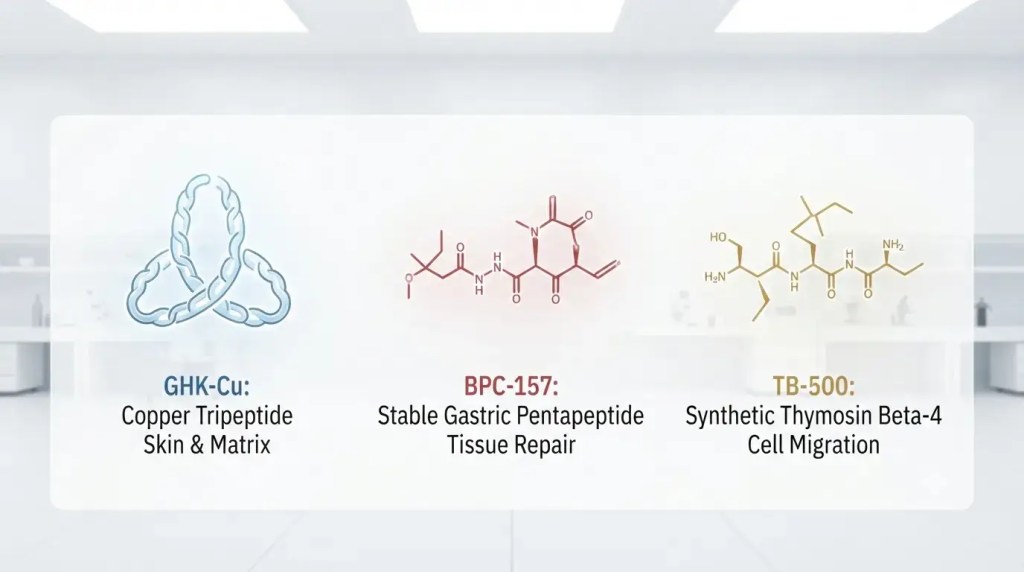
The formulation most commonly associated with the name contains:
- GHK-Cu
- BPC-157
- TB-500 or thymosin beta-4-related material
The exact formulation can vary, which is important when evaluating research or claims about the blend.
A defined pharmaceutical product has a specific active ingredient, standardized manufacturing process, approved indications, and established safety information. A wellness-market peptide blend does not necessarily have those characteristics.
This distinction is especially important because evidence for GHK-Cu, BPC-157, or thymosin beta-4 cannot simply be combined and presented as proof that GLOW itself is clinically effective.
Why Is It Called GLOW?
The name “GLOW” is generally used as a descriptive or marketing term rather than the scientific name of a single molecule.
The name reflects the blend’s association with skin appearance, collagen-related biology, tissue repair, and general recovery.
Because the term is not a standardized pharmaceutical name, the ingredients behind a product called GLOW should always be checked rather than assumed.
Two products using the same name could potentially have different formulations, concentrations, or sources.
What Is GHK-Cu?
GHK-Cu is a copper-binding peptide made from the amino acids glycine, histidine, and lysine in association with copper.
It has been studied in connection with skin biology, extracellular-matrix remodeling, collagen-related pathways, wound repair, and cellular signaling. This is the component of the GLOW concept with the clearest connection to skin-related research.
GHK-Cu has therefore become popular in discussions about skin quality and ageing.
However, there is an important difference between studying GHK-Cu in a particular formulation and assuming that an entire GLOW blend will produce the same outcome.
Topical cosmetic products, laboratory experiments, and experimental peptide combinations represent different contexts and should not be treated as interchangeable.
What Is BPC-157?
BPC-157 is a synthetic peptide that has received considerable attention in experimental research involving tissue repair.
Studies have examined BPC-157 in laboratory and animal models involving areas such as tendons, ligaments, gastrointestinal tissues, blood vessels, and other forms of tissue injury.
These findings are one reason BPC-157 is often included in discussions about recovery and regeneration.
However, most of the available research is preclinical. Findings from animals or laboratory models can help scientists understand possible biological mechanisms, but they do not establish that a compound is a proven treatment for human injuries.
What Is TB-500?
TB-500 is commonly discussed in connection with thymosin beta-4, a naturally occurring peptide involved in cellular processes including actin regulation and cell migration.
Thymosin beta-4 has been investigated in areas such as wound healing, tissue repair, cell movement, and other regenerative processes.
The terminology surrounding TB-500 can be confusing, though. Products marketed as TB-500 should not automatically be assumed to be identical to every research preparation involving thymosin beta-4.
This matters when interpreting scientific evidence because the exact compound, formulation, and experimental conditions can affect the results.
How Is GLOW Peptide Supposed to Work?
There is no single established mechanism for GLOW because it combines several different peptides.
Instead, the proposed rationale comes from the biological properties being studied for each component.
GHK-Cu has been investigated in relation to extracellular-matrix remodeling and collagen-related pathways. BPC-157 has been studied in experimental tissue-repair models, while thymosin beta-4-related research has examined cell migration and repair processes.
The theory behind the combination is that these different biological effects could complement one another.
That idea is interesting, but it remains a hypothesis unless the exact combination is tested in well-designed clinical research.
GLOW Peptide and Skin Health
Skin health is one of the main reasons GLOW has attracted attention.
The strongest biological rationale comes from GHK-Cu. Research has examined its relationship with fibroblast activity, collagen and elastin pathways, extracellular-matrix remodeling, and skin regeneration.
This has led to claims involving:
- Skin texture
- Skin firmness
- Collagen support
- Fine lines
- Skin regeneration
- Overall skin appearance
Some of these claims are biologically plausible, but the evidence depends heavily on the formulation and how the peptide is used.
Research involving topical or cosmetic GHK-Cu, for example, cannot automatically prove that an experimental injectable combination of GHK-Cu, BPC-157, and TB-500 produces the same result.
GLOW Peptide and Collagen
Collagen is an important structural protein found throughout the skin and connective tissues.
Because GHK-Cu has been studied in pathways related to collagen and extracellular-matrix activity, collagen support is frequently mentioned when discussing GLOW.
The underlying biology is interesting, but there is an important difference between influencing a cellular pathway associated with collagen and demonstrating a visible or clinically meaningful improvement in humans.
A laboratory observation is a starting point for research, not proof of a finished treatment.
GLOW and Tissue Repair
Tissue repair is another major area associated with the GLOW concept.
After an injury, the body goes through a series of overlapping processes involving inflammation, cell migration, blood-vessel formation, extracellular-matrix remodeling, and tissue maturation.
Several GLOW-associated peptides have been studied in one or more of these areas.
BPC-157 research has included experimental models of tendon and gastrointestinal injury, while thymosin beta-4 research has examined cell migration and wound-healing biology. GHK-Cu has also been studied in connection with tissue remodeling.
These findings help explain the interest in GLOW.
They do not establish that the complete blend can reliably accelerate recovery from human injuries.
GLOW and Inflammation
Inflammation is a normal part of the body’s response to injury and infection.
It becomes a problem when inflammatory activity is excessive, prolonged, or associated with an underlying disease.
Several of the peptides associated with GLOW have been studied in pathways related to inflammation and tissue repair.
This has led to broad claims that GLOW may “reduce inflammation.”
That description is too general to be scientifically useful. Inflammation differs depending on the tissue, disease, cause, and immune pathways involved.
A finding in a laboratory model therefore cannot automatically be applied to conditions such as arthritis, inflammatory bowel disease, or other chronic inflammatory disorders.
GLOW and Hair Growth
Hair-related claims also appear in discussions surrounding GHK-Cu and peptide blends.
Some research has examined copper peptides and pathways associated with skin and hair biology. However, evidence supporting the complete GLOW blend as a reliable hair-growth treatment is not established.
Hair loss can have many different causes, including genetics, hormones, autoimmune conditions, nutritional factors, medications, and underlying health problems.
That makes diagnosis particularly important. A general peptide claim cannot replace an evaluation of the actual cause of hair loss.
Potential Benefits of GLOW Peptide
The potential benefits associated with GLOW are mostly derived from research involving its individual components.
Areas of scientific interest include:
- Skin biology
- Collagen-related pathways
- Extracellular-matrix remodeling
- Wound-healing research
- Cell migration
- Tissue-repair models
- Inflammatory signaling
- Hair and follicle biology
The evidence is not equally strong across these areas.
GHK-Cu has a more developed connection with skin biology, while much of the BPC-157 and TB-500-related evidence remains preclinical or investigational. Direct evidence for the complete GLOW blend is considerably more limited.

Does GLOW Have a Synergistic Effect?
The idea of synergy is central to many peptide-blend claims.
In theory, combining different peptides could allow them to influence different biological pathways at the same time.
For example, one component might influence extracellular-matrix activity while another affects cell migration or inflammatory signaling.
But synergy cannot simply be assumed because several compounds have individually interesting properties.
To demonstrate that a combination is truly synergistic, researchers would need to study the exact formulation directly and compare it with the individual components.
Without that evidence, synergy remains a proposed explanation rather than an established clinical fact.
Safety and Side Effects
The safety profile of GLOW is not as well established as that of approved medications.
This is partly because GLOW is a blend rather than one standardized pharmaceutical product, and partly because long-term human studies of the complete combination are limited.
Possible concerns with experimental peptide products can include local reactions, irritation, bruising, swelling, allergic responses, contamination, and uncertainty about product purity.
The quality of an unapproved or compounded product can also differ from that of a regulated pharmaceutical.
Even if one component has been studied individually, that does not automatically establish the safety of combining it with other peptides.
Is GLOW Peptide FDA Approved?
GLOW is not an FDA-approved drug product as a named peptide blend.
That distinction is important because FDA approval involves evaluation of a drug’s identity, quality, safety, effectiveness, manufacturing, labeling, and intended medical use.
A compound can have scientific publications and still not be an approved treatment.
Similarly, a peptide appearing in laboratory research does not mean that a commercial blend containing that peptide has been clinically validated.
What Does the Research Actually Show?
The evidence surrounding GLOW is easiest to understand by separating component research from blend research.
There is scientific literature involving GHK-Cu, BPC-157, and thymosin beta-4-related biology. These studies provide information about possible mechanisms and areas worthy of further investigation.
The evidence becomes much weaker when those individual findings are combined and presented as proof of a specific GLOW formulation.
Direct clinical trials evaluating the complete blend would be needed to determine whether the combination provides meaningful benefits and whether those benefits outweigh potential risks.
This is an important principle in medical research:
Evidence for individual ingredients does not automatically prove the effectiveness of a combination.
Frequently Asked Questions
Final Thoughts
GLOW peptide has become popular because it brings together several compounds that each have an interesting research background.
GHK-Cu provides the strongest connection to skin and extracellular-matrix biology. BPC-157 has generated interest through experimental tissue-repair research, while thymosin beta-4-related compounds have been studied in cell migration and wound-healing pathways.
Together, these findings provide a scientific reason to investigate the concept further.
But there is an important gap between interesting biology and proven clinical treatment.
Research involving individual peptides cannot automatically establish that the complete GLOW blend works in humans. Direct evidence for the combination remains limited, and its long-term safety is not fully characterized.
For that reason, GLOW is best described as an experimental peptide blend with several areas of ongoing research, rather than a proven anti-ageing, skin-repair, or recovery treatment.
The most reliable way to evaluate claims about GLOW is to look at the actual evidence behind each component, consider whether the research was performed in cells, animals, or humans, and avoid treating preliminary findings as established medical benefits.
Disclaimer: This article is intended for general educational purposes only. It is not medical advice and does not provide dosing, reconstitution, administration, or self-treatment instructions. Experimental peptide blends should not be used as substitutes for appropriate medical evaluation or evidence-based treatment.